Herbes de Provence

Herbes de Provence
"Herbesdeprovence" by Flickr user: French Tart-FT ( http://www.flickr.com/photos/frenchtart/ ). Licensed under CC BY 2.0 via Wikimedia Commons - https://commons.wikimedia.org/wiki/File:Herbesdeprovence.jpg#/media/File:Herbesdeprovence.jpg

Monday, September 22, 2014

Herb of the Month: Thyme

Thyme, the Namesake of this Blog, as Herb of the Month


Each month, an herb shines in the spotlight: its scent, flavor, even literary associations may make it a candidate for adulation. This month, thyme, also known as Thymus vulgaris, takes the stage.

Thyme is a tiny plant with a bold flavor and scent. In the herb garden, thyme, a perennial,  is easy to grow: just plant it in a reasonably sunny area and water it occasionally. Bees love thyme, so this is a good herb to encourage bee populations--an important consideration in the increasing times of bee colony collapse.
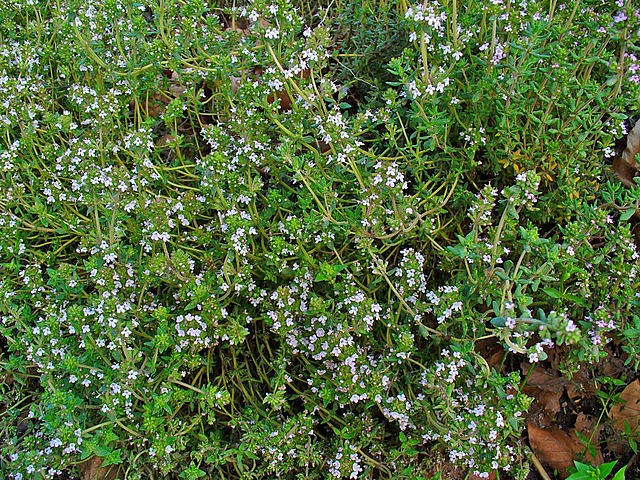
"Thymus vulgaris 001" by H. Zell - Own work. Licensed under Creative Commons Attribution-Share Alike 3.0 via Wikimedia Commons - http://commons.wikimedia.org/wiki/File:Thymus_vulgaris_001.JPG#mediaviewer/File:Thymus_vulgaris_001.JPG


For such a small herb, thyme has a pronounced flavor. Try this herb added to poultry, soups, and stews: perfect for the emerging colder weather. In addition, I like to saute tomatoes with thyme and black pepper for an intriguing side dish.

"Thymus vulgaris". Licensed under Creative Commons Attribution-Share Alike 3.0 via Wikimedia Commons - http://commons.wikimedia.org/wiki/File:Thymus_vulgaris.jpg#mediaviewer/File:Thymus_vulgaris.jpg


Medicinally, this herb contains thymol, which has antiseptic properties. For this reason, many natural mouthwashes contain the essential oil of thyme. Thyme can also be used to treat bronchitis and other infections.

For its versatility and beauty, thyme deserves its place as herb of the month. Enjoy, and bon appetit! 


Monday, September 15, 2014

Fiction, Nonfiction, and Poetry That Inspire the Love of Gardening

Gardening and Literary Inspiration: Read On! 

At this time of year, when the summer garden is all but spent and the fall garden is still but a dream, we need all the inspiration we can get. Literature can provide that inspiration, in spades (pun intended)

Fiction and Nonfiction Books that Inspire the Love of Gardening


Garden Spells, by Sarah Addison Allen

The Secret Garden, by Frances Hodgson Burnett

Diary of a Worm, by Doreen Cronin

The Complete Book of the Flower Fairies, by Cicely Mary Barker

In The Garden Trilogy: Blue Dahlia, Black Rose, and Red Lily, by Nora Roberts

The Care and Handling of Roses with Thorns, by Margaret Dilloway

The Inward Garden: Creating a Place of Beauty and Meaning, by Julie Moir Messervy

The Red Garden, by Alice Hoffman

The Ruth Stout No-Work Garden Book, by Ruth Stout

A Hoe Lot of Trouble, by Heather Webber

Garden of Secrets Past, by Anthony Eglin

Night Gardening, by E. L. Swann

Forget Me Not, by Isabel Wolf

The Memory Garden, by Mary Rickert

The Forgotten Garden, by Kate Morton

Death in the Orchid Garden, by Ann Ripley

Garden of Madness, by Tracy L. Higley

The Star Garden, by Nancy E. Turner

Tomorrow's Garden, by Amanda Cabot

Buckingham Palace Gardens, by Anne Perry

The Dark Garden, by Eden Bradley

In the Garden of Stone, by Susan Tekulve

Walden, or, Life in the Woods, by Henry David Thoreau

Short Stories with a Gardening Emphasis


"Rappaccini's Daughter," by Nathaniel Hawthorne

"The Chrysanthemums," by John Steinbeck

"A Rose for Emily," by William Faulkner (okay, this one is a stretch: enjoy the story anyway)

"The Garden Party," by Katherine Mansfield

"The Occasional Garden," by Saki

"The Garden of Forking Paths," by Jorge Luis Borges


Poetry with a Gardening Theme


"The Garden," by Andrew Marvell

Leaves of Grass, by Walt Whitman

"La Belle Dame Sans Merci," by John Keats

"The Daffodils," by William Wordsworth

"This Lime Tree Bower my Prison," by Samuel Taylor Coleridge

"The Gardener," by Robert Louis Stevenson

"The Deserted Garden," by Elizabeth Barrett Browning

"This is the garden: colors come and go," by e.e. cummings

"The Little Garden," by Amy Lowell


Here's to inspiration: happy reading!

By Simon Speed (Own work) [CC0], via Wikimedia Commons


Monday, September 8, 2014

Pie of the Month: Lemon-Lime Pie


Each month a certain pie--usually a dessert, rather than savory, pie--is showcased. This month, we have the lemon-lime pie, one which does not require much baking time and is served chilled--a boon in my neck of the woods, since September is usually still quite warm, with highs in the 90s during the day.

This recipe makes two pies, enough to treat a large household.

Lemon-Lime Pie

2 graham cracker crusts
12 egg yolks
2 14-ounce cans sweetened condensed milk
2/3 cup lemon juice
2/3 cup lime juice
whipped cream or whipped topping for decoration (optional)

Heat the oven to 350 degrees. Bake the prepared graham cracker crusts for ten minutes; this will help prevent the crusts from getting soggy.

Lemon-Lime Pie, Unadorned


Gently beat the egg yolks and then stir in the condensed milk. Gradually incorporate in the juices, stirring often. Fill the pie crusts and then bake for 30 minutes. Cool the pies completely for several hours; finish the cooling process in the refrigerator. Right before serving, if desired, decorate the pies with whipped cream or topping.

Lemon-Lime Pie, Decorated


Bon appetit!


Monday, August 11, 2014

Herb of the Month: Lemon Balm

Lemon Balm: A Blissful Herb for August


Each month we are focusing on a particular herb, looking at its growing and cooking potential. This month, the honor belongs to lemon balm, also known as melissa officinalis. This member of the mint family is great for inducing and inspiring calm and tranquility.The balm in the herb's name also hints at the health benefits that this plant offers. Lemon balm, according to the University of Maryland Medical Center,  helps to alleviate stress, insomnia, anxiety, and indigestion.

Nicholas Culpeper, the Early Modern author of Complete Herbal and English Physitian (1652), has further suggestions in how to use this herb: he says that it is good for women recovering from childbirth and may be used to disinfect certain skin irritations, among other maladies; not only can lemon balm be steeped as a tea but can also be steeped in wine.

How to Grow Lemon Balm


Pick a nice sunny spot: a large pot or planter box works fine. Either sow the lemon balm from seed or transplant the plants. Water well, as for mint. Once lemon balm is established--give it a couple of weeks--make sure that the herb is watered regularly. Like other members of the mint family, lemon balm will spread if not contained; also, like other members of the mint family, lemon balm is (happily) difficult to kill.

http://upload.wikimedia.org/wikipedia/commons/0/07/Lemon_balm_2.JPG


How to Use Lemon Balm in Cooking


If you want an uplifting herbal tea, look no further than lemon balm. This light, citrusy flavored herb tastes great infused in a tea; sweeteners are optional. As an alternative, you can add the bruised leaves to a pitcher of ice tea and let it set for several hours before drinking for a refreshing beverage. As the Herb Society of America points out, the leaves are better used fresh than dried.

Lemon balm can also be used to flavor poultry and fish, and it can also be added to salad greens. The possibilities are nearly limitless.

Have you yet tried lemon balm? If not, I highly encourage you to try this herb. Bon appetit!


Monday, August 4, 2014

Preserving Options for Garden Riches: Making Chutneys

Making Chutney: A Taste of the Exotic


If you have a surplus of peaches or other fruit, or of vegetables, and you are wanting to do something different with the extra produce, try making chutney, an Indian condiment that offers a sweet-sour-spicy touch to chicken, pork, venison, or vegetarian dishes.

The word chutney comes from Hindi caṭnī.  This versatile accompaniment will delight the senses and the imagination. In honor of August being Peach Month, I recommend this recipe for peach chutney; you might also try mango chutney, tomato chutney, coconut chutney, zucchini chutney (to help prepare for August 8, which is National Sneak Some Zucchini on Your Neighbor's Porch Day), and cilantro mint chutney, to name but a few possibilities. As an added bonus, chutneys make tantalizing, unique holiday gifts.

By Simon Law from Montréal, QC, Canada (Chutneys) [CC-BY-SA-2.0 (http://creativecommons.org/licenses/by-sa/2.0)], via Wikimedia Commons


Quotations about Spices (not many quotations about chutney exist): Food for Thought


“Variety is the spice of life” – American proverb

“Variety's the very spice of life, That gives it all its flavor. – William Cowper

“Is not birth, beauty, good shape, discourse, Manhood, learning, gentleness, virtue, youth, liberality, and such like, the spice and salt that season a man” – William Shakespeare

“I am come into my garden, my sister, my spouse: I have gathered my myrrh with my spice; I have eaten my honeycomb with my honey; I have drunk my wine with my milk: eat, O friends; drink, yea, drink abundantly, O beloved.” – Bible

“He who controls the spice controls the universe.” – Frank Herbert, in Dune

On that note, bon appetit! 


Saturday, August 2, 2014

Bread and First Harvest

Bread as Staff of Life and More

This first weekend in August sees the arrival of Lammas, a time of early harvest. This is a time to celebrate the bounty of the season; since bread is widely regarded as the staff of life, this harvest time is also a time to celebrate the act of making and breaking bread.

Making bread is a time-honored process of transformation: the unassuming ingredients of flour, water, yeast or other leavening, sugar, and salt become a rising dough that, with the kiss of the oven's heat (or, as I discovered one summer, the barbecue pit's heat), becomes a wholesome loaf.

Many varieties of bread exist: you can choose, among other options, white or wheat bread, cornbread (my personal preference this time of year), multi-grain bread, even gluten-free bread. Flat breads such as tortillas, pita bread, or lefse bread are among the myriad of possibilities.


"Mixed bread loaves" by Flickr.com user "FotoDawg" - http://www.flickr.com/photos/fotodawg/111052842/. Licensed under Creative Commons Attribution 2.0 via Wikimedia Commons - http://commons.wikimedia.org/wiki/File:Mixed_bread_loaves.jpg#mediaviewer/File:Mixed_bread_loaves.jpg

Quotes about Bread: Some Inspirational Food for Thought


“All sorrows are less with bread. ” -- Miguel de Cervantes Saavedra

“Here with a Loaf of Bread beneath the Bough,/A Flask of Wine, a Book of Verse - and Thou/
Beside me singing in the Wilderness -/And Wilderness is Paradise enow.” -- Omar Khayyam

“The sky is the daily bread of the eyes.” – Ralph Waldo Emerson

“In the Lord's Prayer, the first petition is for daily bread. No one can worship God or love his neighbor on an empty stomach.” – Woodrow Wilson

“Love doesn't just sit there, like a stone; it has to be made, like bread, remade all the time, made new.” – Ursula K. Le Guin

“It is not accidental that all phenomena of human life are dominated by the search for daily bread - the oldest link connecting all living things, man included, with the surrounding nature.” – Ivan Pavlov

“‘A loaf of bread,’ the Walrus said, ‘is what we chiefly need: Pepper and vinegar besides are very good indeed.’” - Lewis Carroll

“If thou tastest a crust of bread, thou tastest all the stars and all the heavens.” – Robert Browning

“Deliberation, n.: The act of examining one’s bread to determine which side it is buttered on.” – Ambrose Bierce

Here's to making and breaking bread with those we love this weekend. Bon appetit!

Tuesday, July 29, 2014

Preserving Options for Garden Riches: Canning and Pickling

Canning and Pickling: Preserving Possibilities


Two popular, and related, methods of preserving the bounty from the garden and/or the farmer's market are canning and pickling.

Canning is preserving fruits or vegetables by partially cooking them, putting the cooked produced into sterilized glass jars with tight-fitting lids, and then processing them in a hot-water bath or pressure cooker until the lids are hermetically sealed to the jars.

Fruits and vegetables that have a high acid content, such as tomatoes, or where vinegar is added (such as in  my recipe for green salsa) can be safely canned with the hot-water bath method.


Vegetables with a low acid content, such as green beans or corn, should always be processed in a pressure cooker: the hot-water bath method is not safe for these kinds of vegetables.


Pickling is preserving vegetables, such as cucumbers or onions, with a a strong vinegar or brine solution.Some pickles preserve slowly in the refrigerator, as in this recipe for Refrigerator Dill Pickles. while other pickles are processed in a hot-water bath, as in this recipe for Garlic Dill Pickles.

By Dvortygirl (Own work) [GFDL (http://www.gnu.org/copyleft/fdl.html) or CC-BY-SA-3.0-2.5-2.0-1.0 (http://creativecommons.org/licenses/by-sa/3.0)], via Wikimedia Commons


With all of these methods, it is imperative that you sterilize the jars and lids beforehand. Also, plan to take your time with the processing: devoting half a day to canning and/or pickling is not unheard of. Do not try to hurry the process.

What are your thoughts about canning and pickling? Are these preservation methods new to you, or are you a seasoned veteran? Please feel free to share your thoughts in the comments section. Bon appetit!

Friday, July 25, 2014

Preserving Fruits and Vegetables: Freezing and Drying

Two Easy Ways to Preserve the Harvest: Freezing and Drying


It's that time of the year again: the garden is producing beyond your wildest dreams, more than enough to eat fresh and to have some left over. Two ways to preserve those garden riches are freezing and drying.


Freezing


Freezing is a great option for many fruits and vegetables, especially if you can pick them at the peak of flavor: in a home garden, this should be easy enough. For vegetables, I cut them up, as necessary, blanch them, and then lay them out on a cookie sheet in the freezer. Once the vegetable pieces are frozen, I transfer them to freezer bags. Colorado State University offers an excellent guide in choosing the best vegetables for freezing.

I treat fruit similarly, when I dry pack them, except for the blanching: instead, for those that are prone to browning, I dip them in lemon juice before placing them on the cookie sheet. Another option is the syrup pack or sugar pack, depending on the fruit. For a more extensive guide in freezing various types of fruit, it's hard to beat the National Center for Home Food Preservation's document Preserving Food: Freezing Fruit.

By Tiefkuehlfan (Own work) [CC-BY-SA-3.0 (http://creativecommons.org/licenses/by-sa/3.0)], via Wikimedia Commons


Drying


Another easy option for preserving fruits and vegetables (as well as herbs and seeds) is drying. This method needs no refrigeration and is especially handy in preparation for the aftermath of a natural disaster, such as a hurricane or tornado, or in preparation for a zombie apocalypse.

While I am a fan of my Nesco dehydrator, other variations exist. sun drying is possible for many fruits, especially if you are blessed to live in an area with plenty of sun and low humidity. Oven drying is another option for most fruits and vegetables. For additional tips in drying fruits and vegetables, be sure to consult the Virginia Cooperative Extension's page Using Dehydration to Preserve Fruits, Vegetables, and Meats.


Do you have any favorite practices when it comes to freezing or drying produce? Feel free to share your thoughts in the comments section. Bon appetit!


Monday, July 14, 2014

Peach-Strawberry Pie

Pie of the Month: Peach-Strawberry Pie


Happy Bastille Day! At first glance the anniversary of French independence may have nothing whatsoever to do with peach-strawberry pie. However, much like the events that led to the storming of the Bastille, this pie came about through a series of timely and haphazard events (okay, I know this is a stretch, but let's work with it).

This month's pie was born quite by accident. I was planning to make a peach pie for July but then found that I did not have enough frozen peaches; however, I did find that I had enough frozen strawberries to add to the peaches. I tweaked the spices a bit, and came up with this pie.

As always, I suggest serving this pie warm, with a scoop or so of Blue Bell Homemade Vanilla ice cream.

Recipe for Peach-Strawberry Pie

Crust: You can either buy pre-made crust or make your own, depending on time and inclination. If you prefer to make your own, here is a good recipe.

Filling:

3 cups frozen sliced peaches
2 cups frozen sliced strawberries
2 tablespoons lemon juice
1 cup white sugar
1/2 cup all-purpose flour
splash of vanilla extract
1/2 teaspoon cinnamon
2 tablespoons butter, cut into pieces

Preheat the oven to 400 degrees Fahrenheit.

Place the frozen fruit in a large bowl and sprinkle with lemon juice; stir. In a separate bowl, combine the sugar, flower, and cinnamon. Mix the dry ingredients with the fruit until well blended, and then add the vanilla extract.

Line a pie pan with the bottom crust. Perforate the bottom of the crust with a fork. Add the fruit mixture and spread evenly throughout the pan. Roll out and place the top crust onto the pie; seal the edges and then flute them. Make decorative slash marks in the pie so that pressure does not build up inside the pie.

Bake for about 45-55 minutes, or until the crust is golden brown.

Bon appetit!

Peach-Strawberry Pie (own photo)


Friday, July 11, 2014

Make Weeding Fun--No, Really!

Weeding Can Be More Fun, with a Little Imagination


When most people think of weeding, the word fun rarely comes to mind. After all, weeding is drudgery, a chore, a punishment that ranks up there with the rack and the thumbscrew, right? With a little imagination (okay, more than a little imagination), weeding can become enjoyable, even amusing. Read on for some decidedly tongue-in-cheek suggestions.

* Go Shakespearean on those weeds. Practice reciting the "Alas Poor Yorick" speech by Hamlet in The Tragedy oHamlet, Prince of Denmark:, holding aloft a tuft of pulled weeds:

"Alas, poor Yorick! I knew him, Horatio: a fellow
of infinite jest, of most excellent fancy: he hath
borne me on his back a thousand times; and now, how
abhorred in my imagination it is! my gorge rims at
it. Here hung those lips that I have kissed I know
not how oft. Where be your gibes now? your
gambols? your songs? your flashes of merriment,
that were wont to set the table on a roar? Not one
now, to mock your own grinning? quite chap-fallen?
Now get you to my lady's chamber, and tell her, let
her paint an inch thick, to this favour she must
come; make her laugh at that." -- Act V, Scene 1

Really ham it up. As a variation, try reciting this speech in a falsetto voice. 

* Sing "Let It Go" from the Disney movie Frozen, at the top of your lungs, while you are picking weeds--preferably with a flourish. Even better: visualize an icy frost emanating from your fingers as you touch those weeds. Note: If you have small children or if your neighbors do, they will probably join you in singing "Let It Go." While they are singing, you might be able to get them to weed a bit on your behalf.

* Play poker, using the weeds as currency. This works better if you can convince up to three other people to join you in this activity. Seven Card Stud or Texas Hold'Em, anyone?

* Create a mini-bonfire for those pulled weeds (use a fire-safe container) and dance around the fire with wild abandon.

Happy weeding!

"Tripleurospermum perforatum 20041012 2572". Licensed under Creative Commons Attribution-Share Alike 3.0 via Wikimedia Commons - http://commons.wikimedia.org/wiki/File:Tripleurospermum_perforatum_20041012_2572.jpg#mediaviewer/File:Tripleurospermum_perforatum_20041012_2572.jpg
.